Hongshi Optoelectronics Explained.
Each article starts with a simple question and explores one principle.
This time, we start with a glass cube: how can red, green and blue light enter from different directions and leave in the same direction?
At the center of a typical three-color light engine used in an optical display system sits a glass cube only a few millimeters on each side. This ordinary-looking component combines the three light paths.
At first glance, it is easy to mistake it for a single piece of glass and assume that refraction simply bends the light before it leaves through another face.
The key to combining the light is inside the cube.
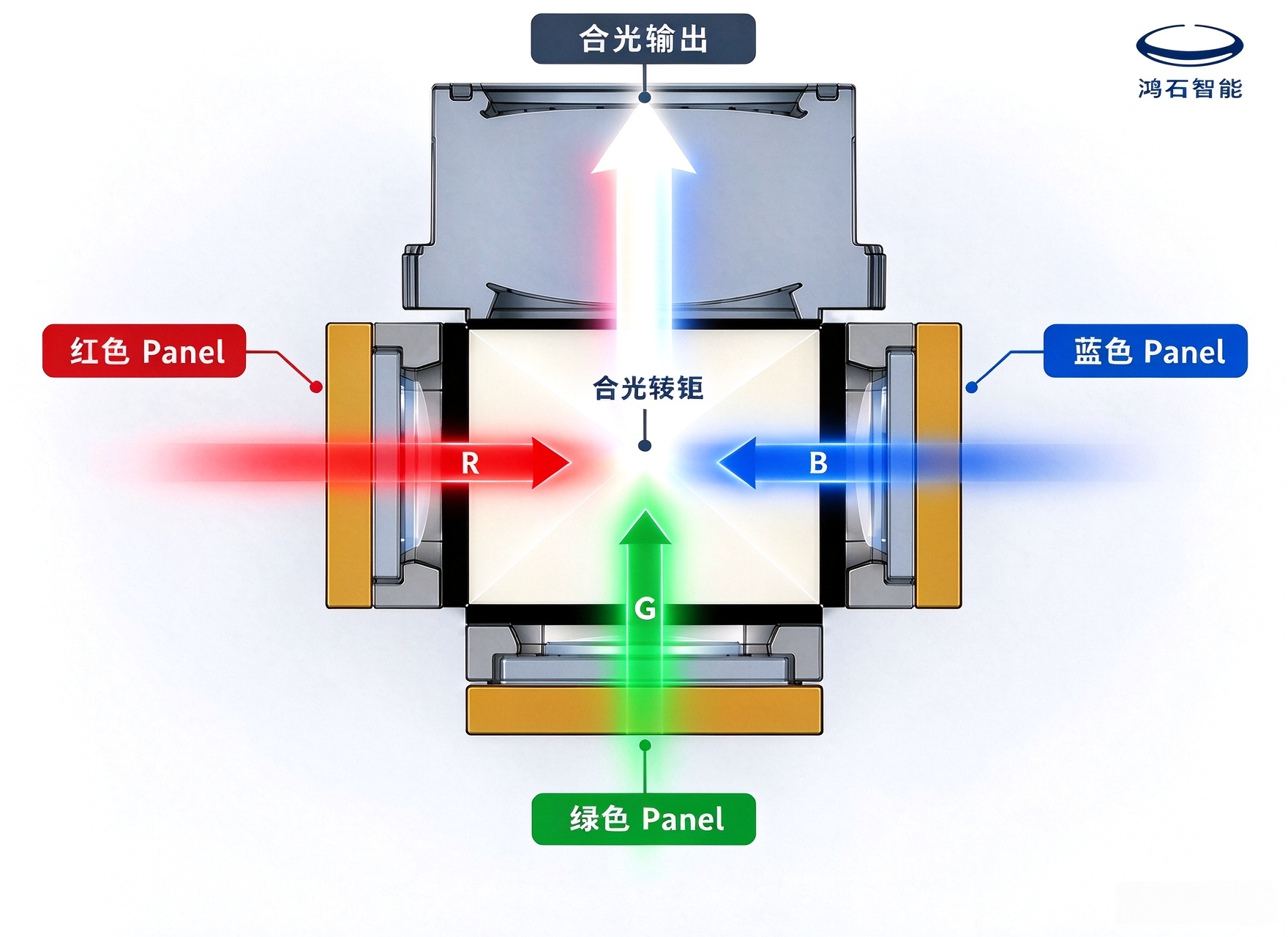
A Cube Assembled from Four Prisms
A typical RGB color-combining prism is made from four right-angle prisms with isosceles triangular cross-sections, cemented together. Viewed in cross-section, their internal interfaces follow the two diagonals of the square, forming an X-type. These interfaces carry two sets of optical coatings with different functions, commonly known as dichroic coatings.
Building the cube from separate prisms allows the relevant surfaces to be coated before assembly. The coated surfaces can then be enclosed inside the cube and held at the positions and angles required by the optical design.
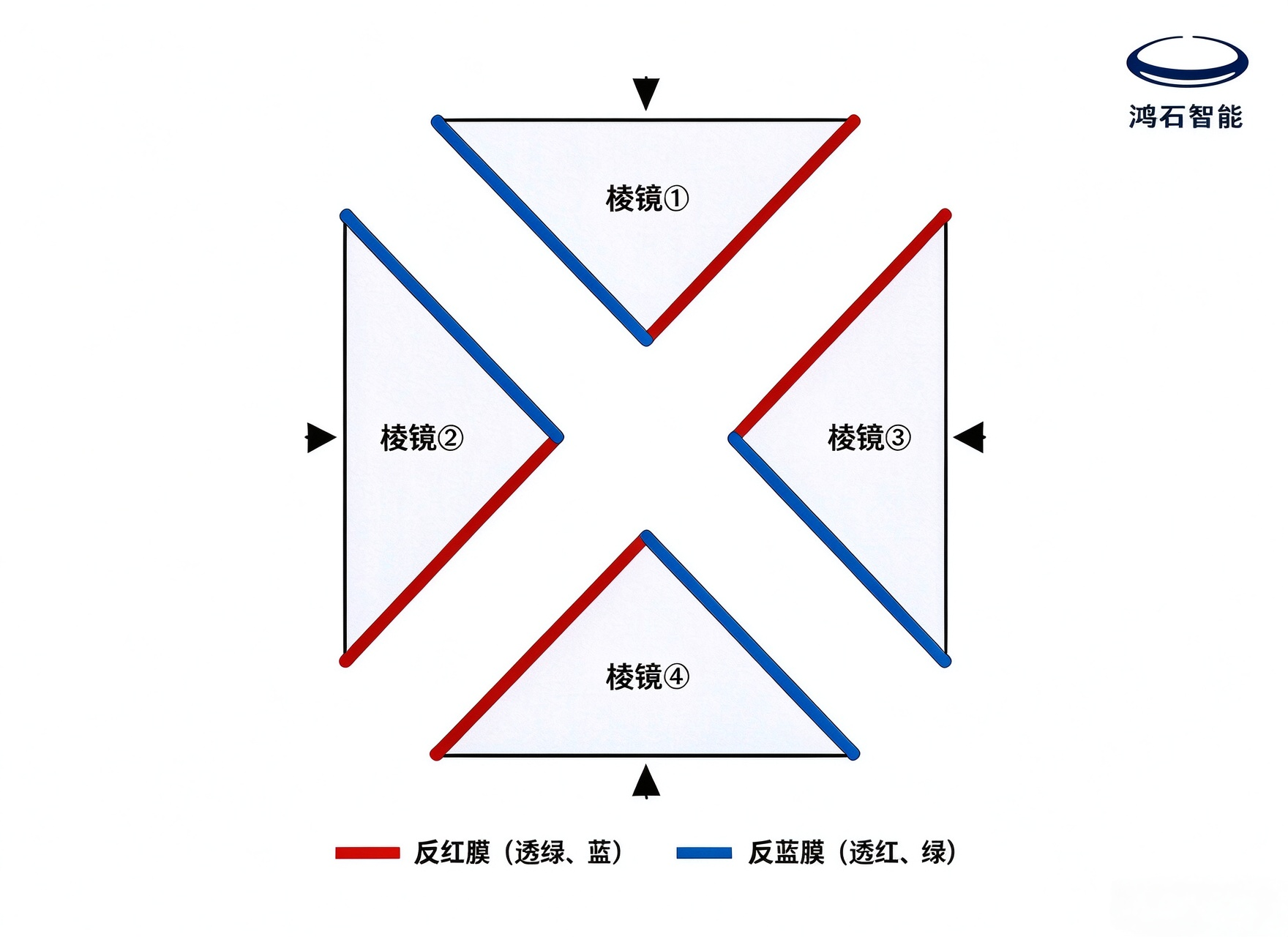
Two Sets of Coatings Redirect the Light
In a common design, one set of coatings mainly reflects red light while transmitting green and blue. The other mainly reflects blue light while transmitting red and green. These coatings act as color-selective mirrors: they reflect one color and provide a transparent window for the other two.
Red and blue light enter from opposite sides. Each is reflected by its corresponding coating toward the same exit face. Green light passes through both sets of coatings and continues forward. All three colors then share a common output path.
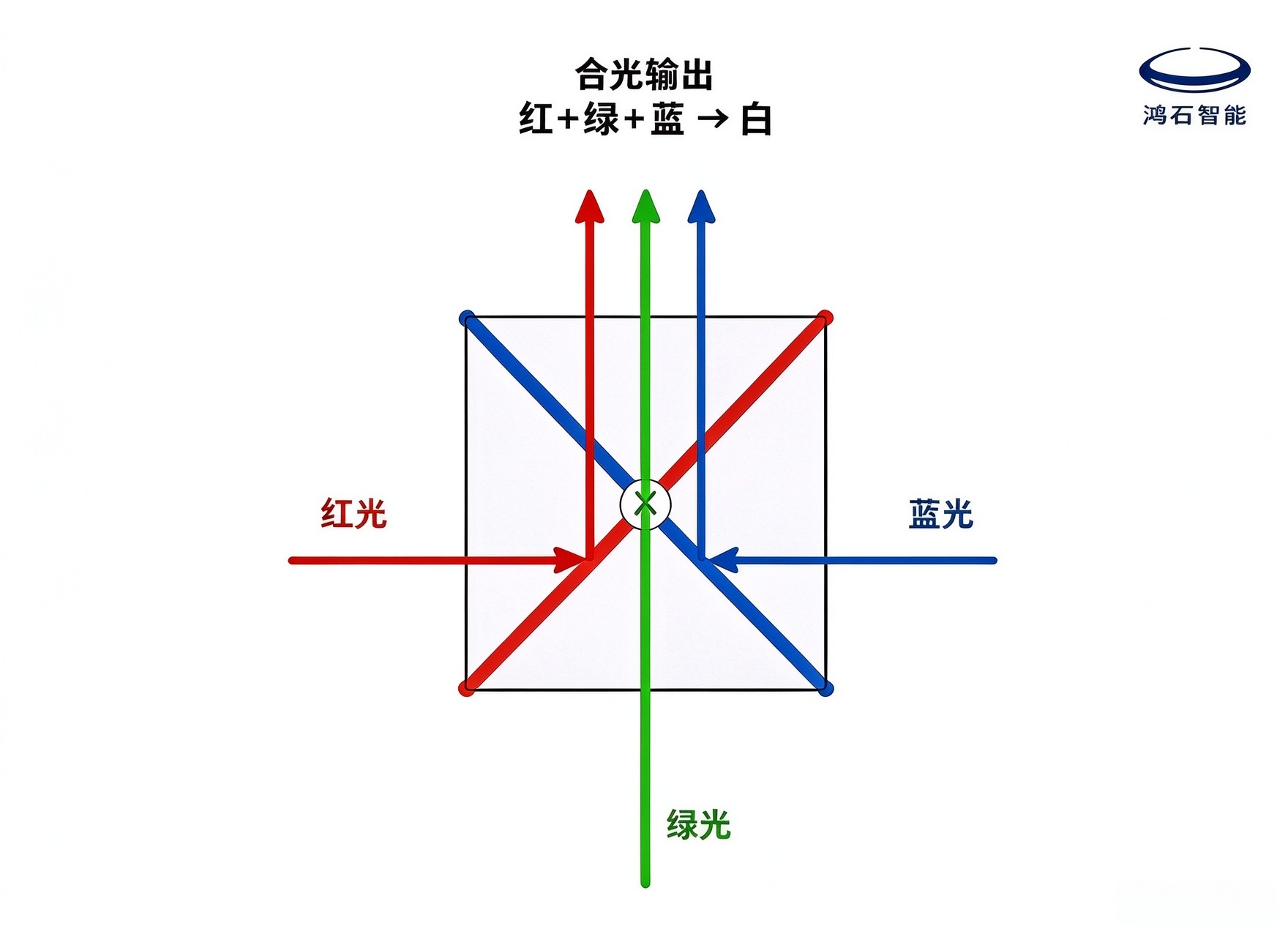
How the Combined Light Produces White
Consider a white point in an image. When red, green and blue light overlap accurately at the corresponding image position, with the appropriate relative intensities, we perceive white as the light reaches our eyes through the rest of the optical system. This is additive color mixing.
White light does not correspond to a single wavelength. The prism brings different colors into a shared output path; the white we see results from their combined effect on our visual system.
What makes this glass cube work is the different role of each set of coatings inside it.