From Pixel Emission to Image Output
In Hongshi's MicroLED optoelectronics series, each article starts with a simple question and explains the principle behind it.
A MicroLED display emits its own light. Why does a light engine still need a lens assembly?
Optical diagrams usually show light traveling along a few lines with arrows. A real MicroLED pixel emits light in many directions at once. Often, only some of that light reaches the lens assembly and enters the imaging path.
One of the light engine's main jobs is to collect light from the pixels and direct it as required for imaging.
Light from a single pixel spreads in different directions
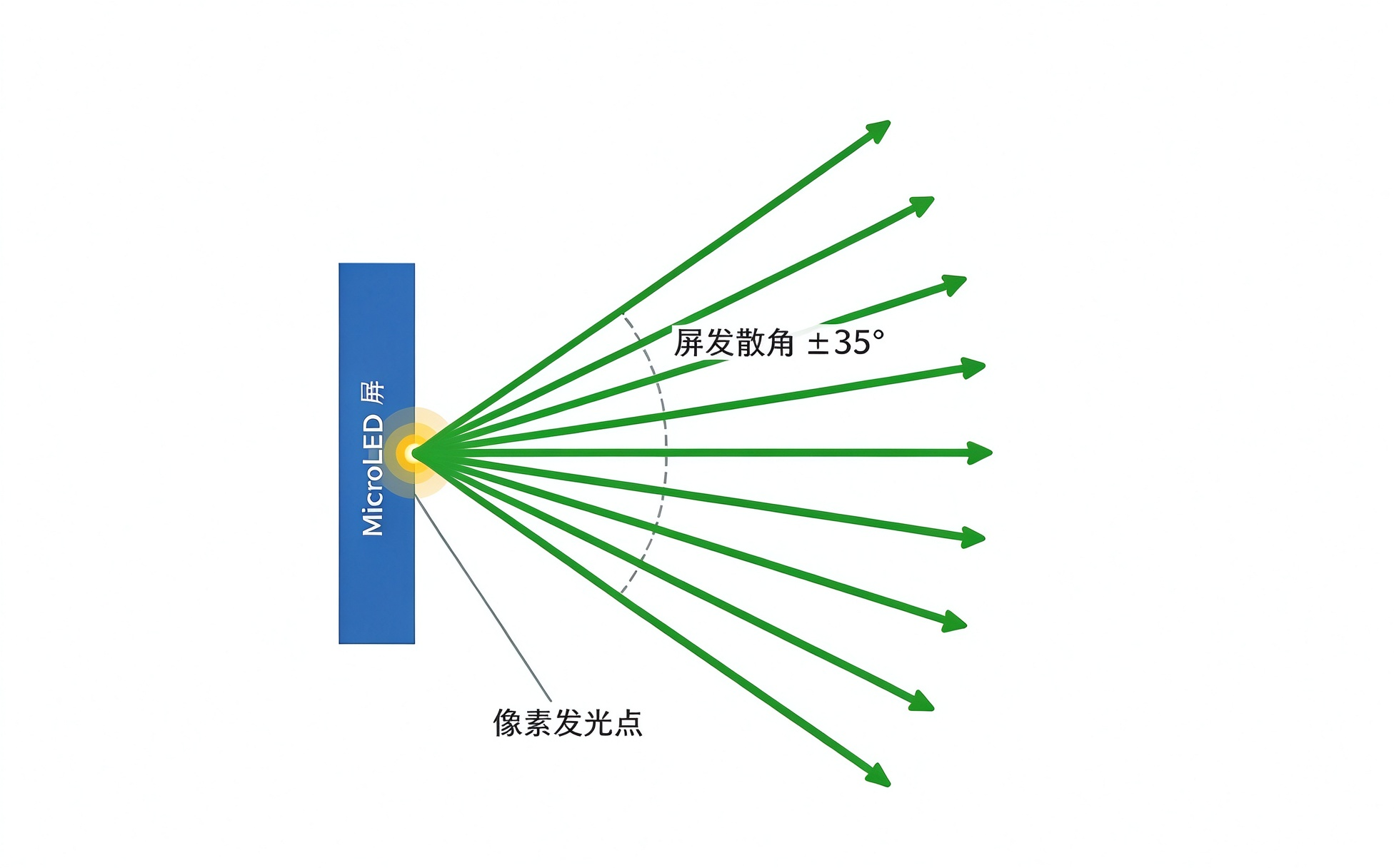
On the emitting side of the display, a lit MicroLED pixel sends light out over a range of angles. The intensity can vary with direction, depending on the chip design and its light extraction structures.
Think of light fanning out from a single point. Some rays travel almost straight ahead; others head off to the sides. Before reaching an optical element, this diverging beam spreads over a larger area as it travels.
The pixel may be tiny, but its beam still widens with distance. To collect the light, the lens assembly's receiving area needs to match where the rays arrive.
How the lens assembly collects and redirects light
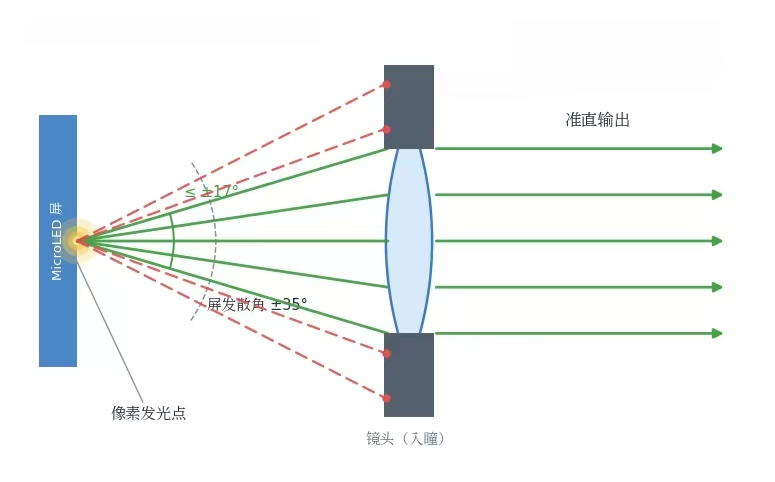
A lens assembly can only accept light within a limited range. Consider a simplified model in which a light source faces an opening and both remain in fixed positions. A larger clear aperture generally admits light over a wider range of angles. Light that falls outside the aperture cannot pass through that opening into the rest of the optical path.
Imagine two rays leaving the same pixel. One enters the lens assembly; the other passes beyond its edge. Both come from the pixel, but the second ray is not collected and cannot contribute to the image along this optical path.
As light passes through the lenses, refraction changes its direction.
Take collimated output as an example. With a suitable lens design and microdisplay position, the collected light from a single pixel can emerge as a nearly parallel beam. This is the basic idea of collimation.
Pixels at different positions correspond to different output directions. For example, pixels at the center and edge of the image produce beams that leave the lens assembly in different directions. This relationship between pixel position and beam direction preserves the image's spatial information. To be used effectively, the output light must also meet the acceptance requirements of the optical system that follows.
Light collection also limits miniaturization
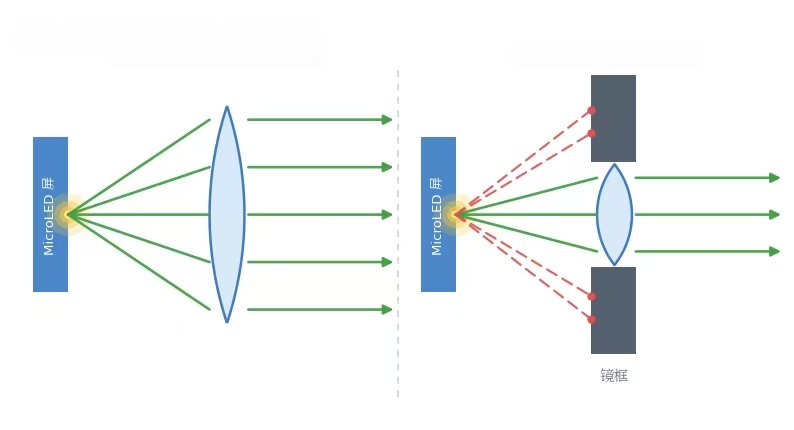
If all other optical conditions remain unchanged, reducing only the effective aperture that limits the beam may block some light that previously passed through. When making a light engine smaller, designers therefore need to check whether the lens assembly can still collect enough light.
In practice, the pixel's angular emission pattern, the lens assembly's acceptance range and the output requirements need to be considered together. The optical path can then be adjusted to make better use of the light within the available space. After those adjustments, the amount of usable light and the image quality should both be checked against the design requirements.